


Coming Soon!
Top picks for you
-


 Up to $42.49 off
Tidal Trekker
Tidal Trekker 35L Insulated Cooler Backpack
20% OFF$169.95$212.44Savings $42.49Unit price /Unavailable -

-
 $87.55 off
-

-
 $42.05 off
Fishing Superstore
32% OFF$89.95$132.00Savings $42.05Unit price /Unavailable -

GENESIS
GENESIS Stainless Steel Propeller - Suzuki/Mercury/Tohatsu 35/60hp Outboard Motor P13
$504.00Unit price /Unavailable -
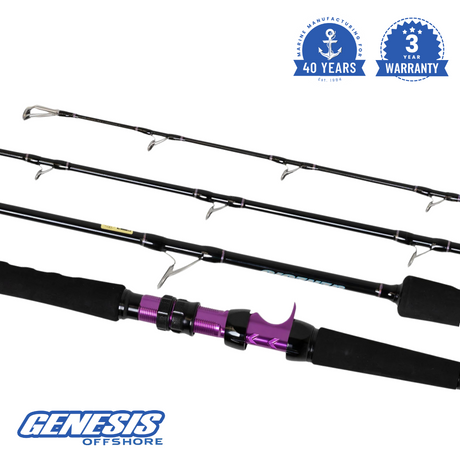
GENESIS
GENESIS 25kg Class I Straight Guide - Carbon Kevlar Jigging Rod
$325.00Unit price /Unavailable -


A gaff is a hook on a pole, used to bring a large fish into a boat or onto a kayak once it has been played to the side. It is a simple tool, but it is one of the most important pieces of safety and landing gear for anyone chasing fish around the metre mark, and it is easy to underestimate until a good fish is beside the boat and there is nothing to land it with. This page explains how a gaff works, what to look for when choosing one, how to use it safely and what we currently stock, which is the Rig Ezy 90cm Extendable Gaff.
Read More
What a Gaff Does
A gaff hook is driven into a fish so you can lift it out of the water in one controlled movement. It saves your hands from the fish, and it gives you a way to land a fish that is too big or too lively to lift by the leader. It is the right tool for a fish you plan to keep. A gaff is not the right tool for a fish you plan to release, because the hook leaves a wound, so a net or a firm grip on the lower jaw is a better choice for fish you want to return. Local rules on what you can keep and release differ between states and can change, so check the current rules with your state fisheries department before you fish.
The Rig Ezy 90cm Extendable Gaff
The Rig Ezy 90cm Extendable Gaff is our current gaff. The maker says it handles fish around the metre mark and is made for tinnies and kayaks, where space is limited. The hook is stainless steel with an offset of approximately 45 percent, which the maker says gives a secure gaffing action. The body is lightweight aluminium, the handle has a non-slip grip that the maker says stays firm and safe when wet, and the gaff has three telescoping sections that extend to a maximum of 90cm. When it is collapsed it is much shorter than a fixed gaff, so it is easier to store in a small boat or a kayak. It is a compact gaff for smaller craft, so for fish well beyond that size a longer, heavier gaff may suit better.
Choosing a Gaff
Think about the fish, the boat and the reach you need. A longer gaff helps from a larger boat with a high freeboard, where you need to reach down to the water. A shorter, extendable gaff suits a tinny or kayak, where there is less distance to cover and less room to store it. Check the hook, because a gaff is only as good as its hook. Stainless steel resists corrosion in salt water, and a thick, sharp hook with a good gap will hold a heavy fish. The handle matters too, since a wet, slippery handle is dangerous with a fish on the end. Look for a non-slip grip and a locking mechanism that will not collapse when you need it.
Using a Gaff Safely
A gaff is sharp, and a thrashing fish on the end of it can be dangerous. The maker's advice for the Rig Ezy is to face the hook downward and toward the boat, aim for the forward shoulder or the top of the fish's head, which gives control and protects the meat, and retrieve hand over hand to avoid bending the gaff. Do not gaff until the fish is tired and close to the side of the boat. Have a second person ready to help if you are fishing in a larger boat. Keep your body clear of the hook and the line, and watch for treble hooks on the lure, since a lure with a fish on it can swing loose. Keep the hook covered or stored when it is not in use, because a gaff left on the deck is a hazard.
On a Kayak
A kayak is a challenging place to land a big fish, and a compact extendable gaff is a good fit. Keep the gaff secured where you can reach it, such as under a bungee, and extend it before you need it. Land the fish beside the kayak, not over the bow or stern, and keep your weight low and centred. A good fish can pull a kayak around, so be careful when you lift it. Our kayaks and SUPs collection has more gear for paddle fishing.
Species and Lures
A gaff is most useful for fish that are too big to lift by the leader, and offshore species are the usual candidates. Kingfish, giant trevally and mahi mahi are all fish that can reach a size where a gaff is useful, and our kingfish lures, giant trevally lures and mahi mahi lures pages cover how to target them. Match the gaff to the size of the fish you expect, and have it ready before you start fishing, because the fight is the worst time to go looking for it.
Caring for Your Gaff
Rinse the gaff in fresh water after every salt trip, and let it dry fully before you collapse it, since salt trapped between sections can make it stiff. Check the hook for rust, bending or a dull point, and replace the gaff if the hook is damaged. Wipe down the sections and check that they extend and lock smoothly. Store it somewhere it will not be knocked or bent, with the hook covered. Our boat accessories collection has other gear for the boat.
Landing Gear Checklist
Landing a fish well takes more than a gaff. Have a pair of pliers or a de-hooking tool, a bucket or an esky for the catch, a towel or gloves to help with handling and a first aid kit in the boat, in case of a hook injury. Think through the sequence before you hook the fish, so everyone on board knows who does what. Practise extending and using the gaff at home, so the movement is easy when it counts.
The Most Common Mistake
The mistake we see most often is leaving the gaff until the moment it is needed. A gaff buried under gear, still collapsed, is no use when a good fish is beside the boat. Keep it in reach and ready to use. The second common mistake is gaffing too early, before the fish is tired, which can lead to a dangerous thrash on the end of a sharp hook.
Frequently Asked Questions
A gaff is a hook on a pole that is used to bring a large fish into the boat, once it has been played to the side.
The maker says it handles fish around the metre mark.
It has three sections and extends to a maximum of 90cm.
The maker says the hook is stainless steel with an offset of approximately 45 percent.
The maker says it is made for tinnies and kayak fishing, and its extendable design suits limited storage space.
The maker advises facing the hook downward and toward the boat, and aiming for the forward shoulder or the top of the fish's head.
A gaff leaves a wound, so use a net or another method for fish you plan to release, and check the rules for your state.
Rinse it in fresh water after each salt trip, let it dry fully, and check the hook for rust or damage.

Someone bought fishing reels
2 min ago